

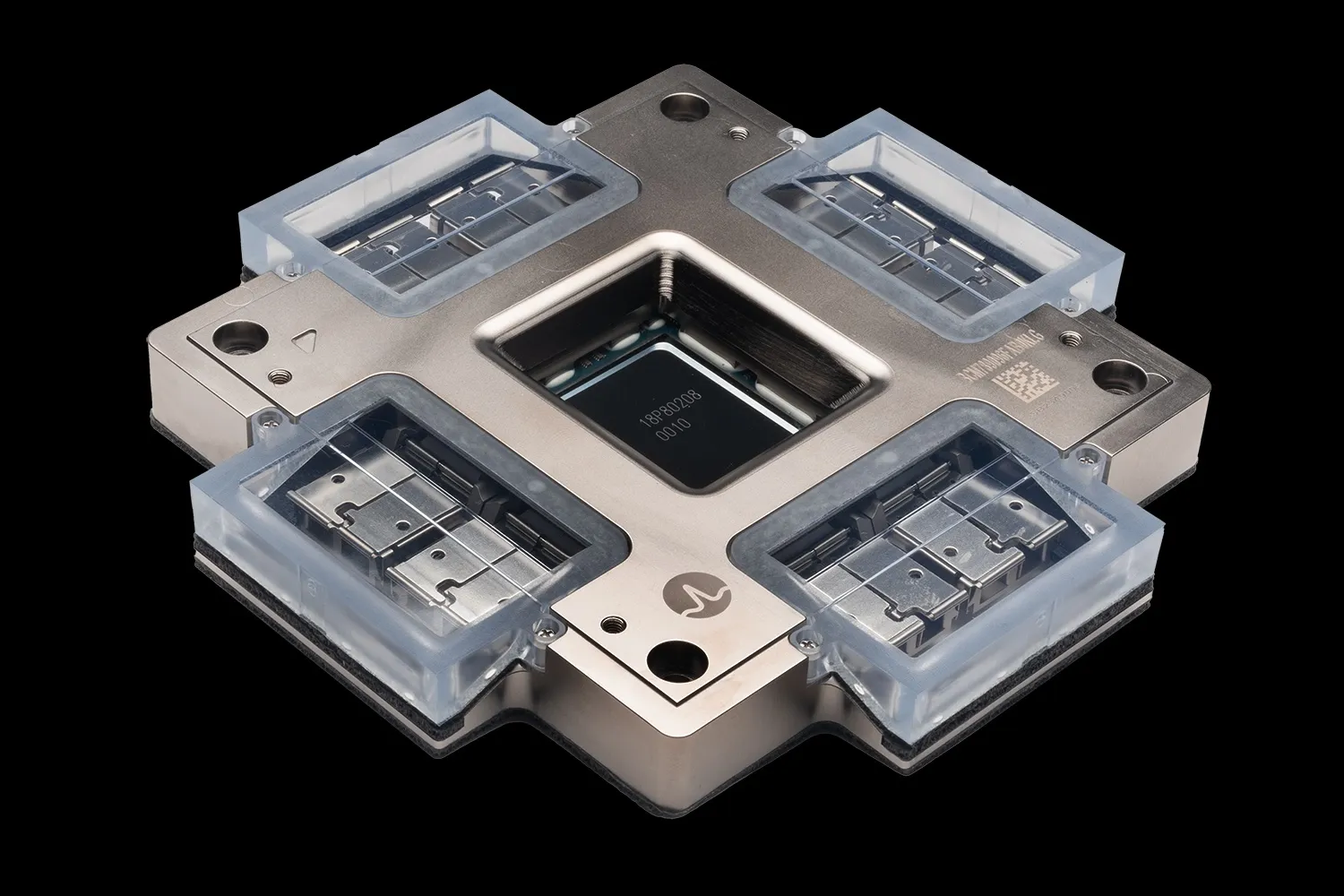
Copackaged optics represents one of those engineering solutions that emerges when an existing approach has been pushed as far as it can go and the demands placed upon it continue to grow. For decades, the dominant architecture in high-speed data centre switching placed optical transceivers at the edge of the network switch, connected to the switching silicon by electrical traces running across a printed circuit board. That arrangement worked well enough when data rates were measured in tens of gigabits per second. As the industry moved toward hundreds of gigabits and then toward terabit speeds, the electrical interconnect between the transceiver and the switch began to consume power, generate heat, and introduce signal degradation at a rate that the architecture could no longer sustain. Copackaged optical technology was developed to address precisely that impasse.
The Architecture That Changes the Equation
The fundamental innovation in copackaged optics architecture is the physical relocation of the optical engine. Rather than placing transceivers in a cage at the front panel of a switch and running electrical signals across the board to the switching silicon, copackaged optics places the optical components directly alongside the switch chip, integrated within the same package or mounted immediately adjacent to it on the same substrate.
The distance that the electrical signal must travel is reduced from centimetres to millimetres. That reduction has consequences that cascade through the system. Signal integrity improves because shorter electrical paths accumulate less noise and distortion. Power consumption falls because the SerDes circuits that drive signals over longer electrical distances are among the most power-hungry components in high-speed systems, and at shorter distances they operate more efficiently or can be simplified. Thermal management becomes more tractable because the heat generated by the optical and electrical functions can be addressed within a compact, integrated package rather than distributed across a large board area.
Co-packaged optical systems require a fundamental rethinking of how optical and electronic functions are partitioned, packaged, and cooled. The optical engines used in copackaged implementations are purpose-built for the constraints of the environment: tight thermal budgets, compact footprints, and the need to couple light into fibre connections without the mechanical connectors that front-panel transceivers have always relied upon.
Performance Benefits Across the System
The performance advantages delivered by integrated copackaged optics extend beyond the switch itself to the broader data centre architecture it operates within.
Bandwidth density
Placing optical engines adjacent to the switch silicon removes the electrical bandwidth bottleneck that limits how many high-speed lanes can be routed to the front panel. Copackaged implementations can support significantly higher aggregate bandwidth per switch than pluggable transceiver architectures of equivalent switch silicon area
Power efficiency
Published industry analyses have indicated that copackaged optics can reduce the power consumed by optical interconnects within a switch by 30 to 50 per cent compared to pluggable alternatives at equivalent data rates. In a data centre environment where interconnect power represents a substantial fraction of total facility energy consumption, that reduction has material operating cost implications
Signal integrity at scale
As data rates per lane push beyond 100 gigabits per second, the electrical channel from switch to pluggable transceiver becomes increasingly difficult to manage. Copackaged optics sidesteps that challenge by shortening the channel to a length where signal integrity can be maintained without the equalisation overhead that longer connections require
Thermal co-design
The compact integration of optical and electronic functions allows thermal solutions to be designed for the combined package rather than managed separately, enabling more efficient heat removal and more predictable thermal behaviour under varying load conditions
Manufacturing and Packaging Challenges
The architecture’s performance advantages do not come without demanding manufacturing requirements. Copackaged optics packaging requires precision assembly processes that bring optical alignment tolerances measured in fractions of a micron into contact with the high-volume, cost-sensitive economics of data centre hardware production.
Coupling light from the optical engine into single-mode fibre, or between chip-scale waveguides and fibre arrays, requires passive or active alignment processes capable of maintaining submicron positional accuracy through the thermal cycling, mechanical stress, and vibration that the packaged product will experience in service. The materials used for optical coupling, including precision lens arrays, fibre ferrules, and photonic integrated circuit edge couplers, must be compatible with the assembly processes and the thermal environment of the package.
Singapore has invested in the precision manufacturing and photonics packaging infrastructure that copackaged optics production demands. Its advanced packaging facilities, supported by research programmes in photonic integration and precision assembly, have positioned the country as a contributor to the supply chains developing next-generation co-packaged optical components for data centre and telecommunications applications. The combination of semiconductor packaging expertise and optical assembly capability that Singapore has developed reflects a deliberate positioning at the convergence of two industries whose futures are increasingly intertwined.
The Direction the Industry Is Moving
The transition from pluggable transceivers to copackaged optical interconnects is not a distant possibility. It is an active programme across the major switch silicon developers, optical engine producers, and data centre operators who understand that the electrical interconnect bottleneck becomes more acute with every new generation of switching silicon that increases per-chip bandwidth.
History suggests that once the performance advantage of a new approach becomes sufficiently compelling, adoption follows with a speed that surprises those who underestimated the pressure driving the change. The pressure driving copackaged optics has been building for years, and the engineering work required to make it manufacturable at scale is well advanced. When it reaches the scale its proponents anticipate, it will reshape data centre architecture in ways that will be remembered as a significant turning point in the history of copackaged optics.
